
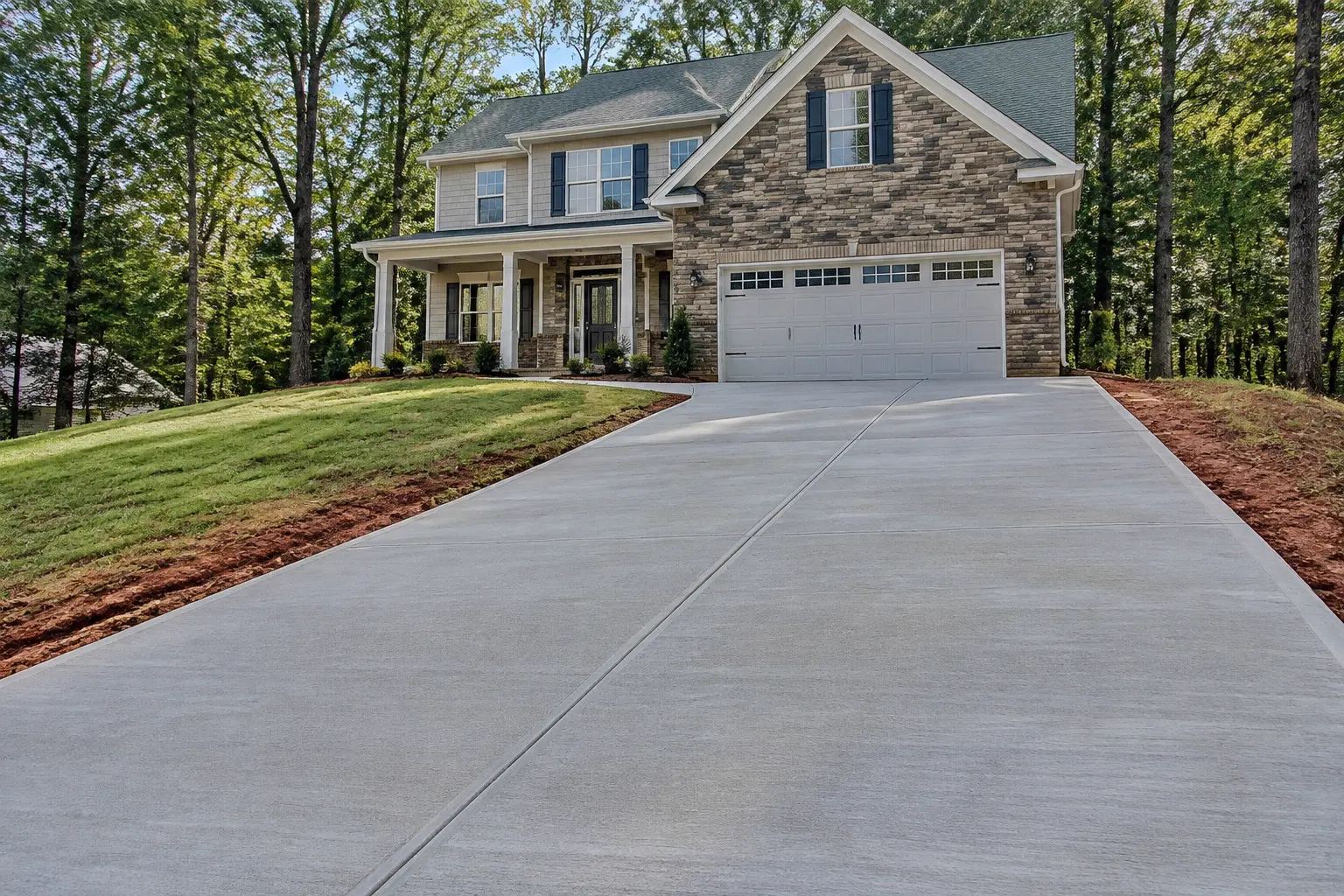
Cracked or Sinking Concrete Driveway? Why We Replace Instead of Patch
November 22, 2026
A concrete driveway is the largest piece of concrete most homeowners will ever buy, and when it fails, the cause is almost always underneath it. In West Georgia, that usually means red clay that swells when it's wet and shrinks when it's dry, a base that was too thin or never compacted, and runoff that washes the soil out from under the edges on a sloped lot.
That's why we don't patch, resurface or overlay failing driveways. A coating on top can't fix a problem underneath, so the cracks come back. We tear the old slab out, rebuild the base and pour a new driveway designed for Georgia clay. This guide covers the signs a driveway is done, why driveways fail here, what replacement involves and what it costs.
Signs your driveway needs replacing, not patching
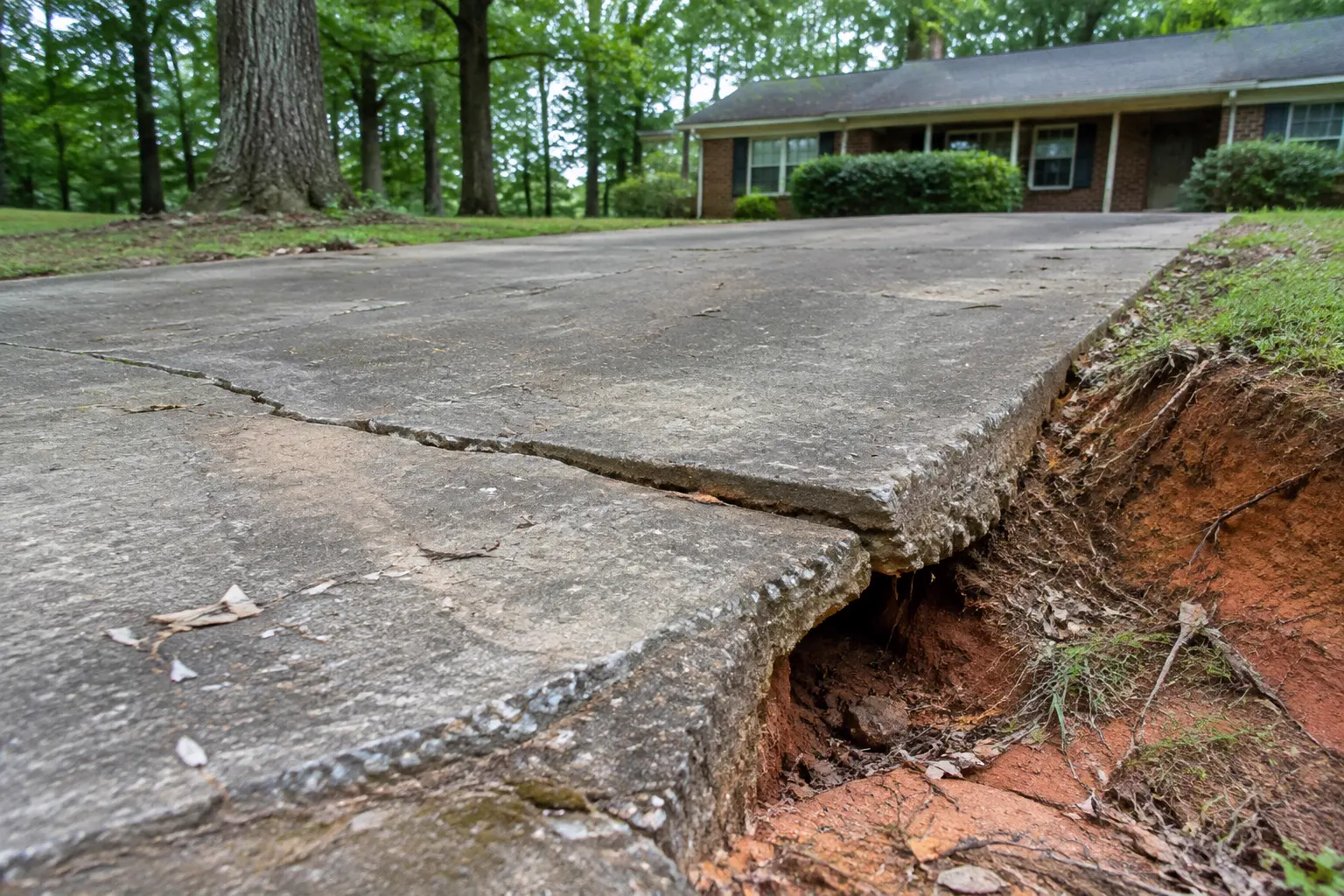
- Cracks wider than about a quarter inch, or cracks that keep growing
- One section of slab sitting higher or lower than the one next to it, creating a trip edge
- Sections that have sunk, tilted or pulled away from the garage, walkway or street
- Edges that are crumbling or broken, with soil washed out underneath
- Spider-web cracking across large areas, which usually points to a weak base
- Water pooling on the driveway or running toward the house or garage
- Surface scaling and pitting across most of the driveway
- Patches, sealants or overlays from earlier repairs that have already failed
One hairline crack isn't a reason to replace a driveway. Several of these together, or movement that gets worse after every heavy rain, means the problem is under the slab.
Why driveways fail in West Georgia
- Clay soil movement: Georgia red clay expands when it's saturated and shrinks in dry spells. Without a proper compacted base between the clay and the concrete, the slab rides those movements until it cracks.
- A thin or missing base: some driveways are poured with little or no gravel base, or on fill dirt that was never compacted. The slab settles wherever the soil underneath settles.
- Water: runoff from a sloped yard, downspouts dumping at the edge of the drive, or a driveway graded toward the house all wash soil out from under the slab.
- Thin concrete or no reinforcement: a slab that's too thin, or poured without rebar or wire mesh, can't spread heavy loads.
- Missing or late control joints: concrete shrinks as it cures. Joints cut in the right places at the right time decide where it cracks. Without them, it cracks wherever it wants.
- Heavy loads and roots: delivery trucks, RVs, trailers and tree roots all add stress the driveway may not have been built for.
Why patching and resurfacing rarely last
Crack fillers, resurfacing coats and overlays change how a driveway looks. They don't change what's underneath it. If the base is weak or the clay is still moving, the cracks reflect back through the new surface, the overlay can start to flake or peel, and you end up paying for the same driveway twice.
Slab lifting can raise a section that has settled, but it doesn't fix a slab that is already broken into pieces, crumbling at the edges, or sitting on soil that keeps washing out. When the slab itself is failing, replacement is the only lasting fix. That's why we only do full demo and replacement, not repairs.
What a full demo and replacement involves
- On-site estimate: we measure the driveway, check the grade and drainage, and look at what caused the old slab to fail.
- Demolition and haul-off: the old driveway is broken out and hauled away, including the apron if it's part of the job.
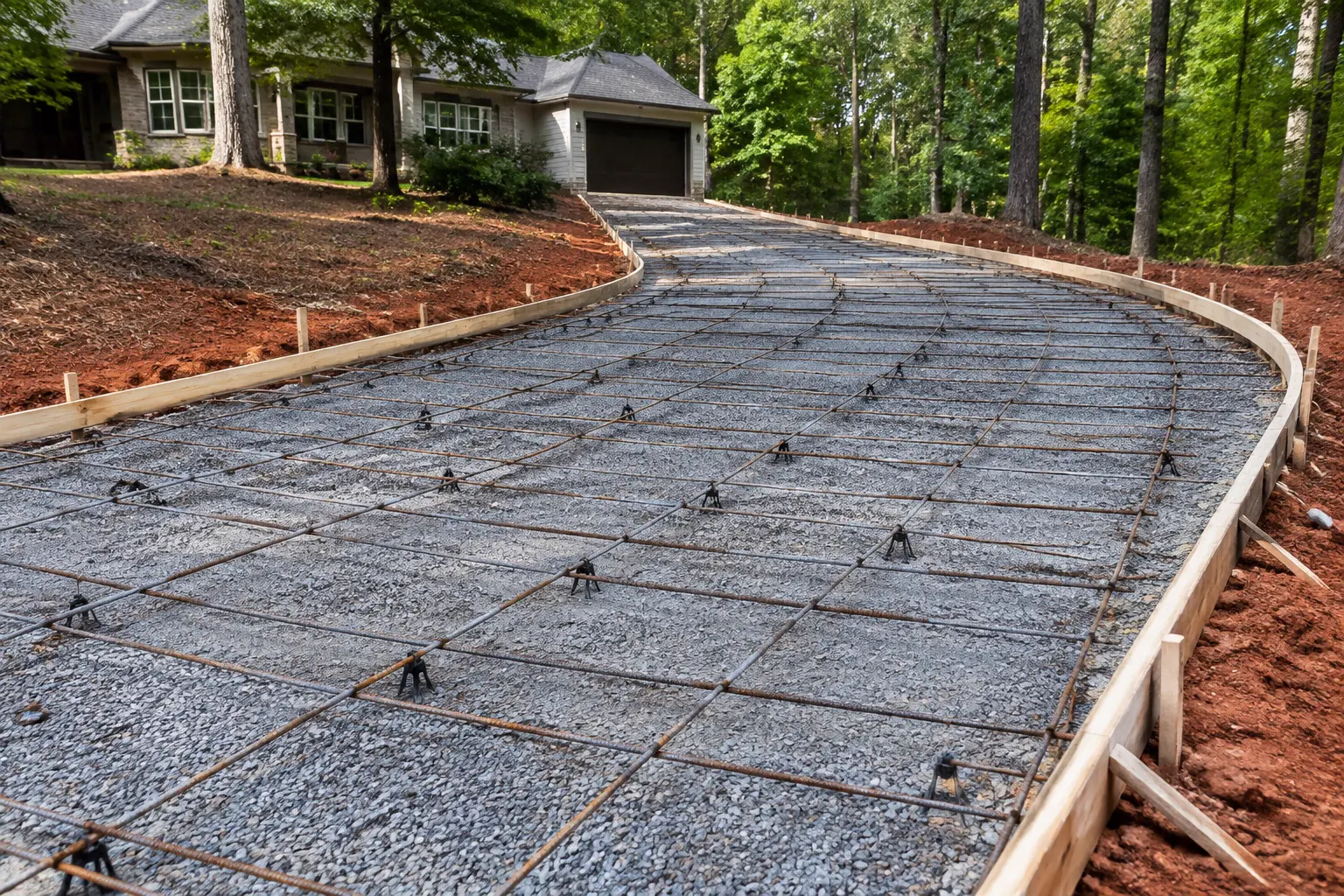
- Grading and base preparation: we grade for drainage and build a compacted aggregate base made for Georgia clay soils, so the new slab has something solid to sit on.
- Forming and reinforcement: forms are set to the right elevation and slope, and rebar or wire mesh is placed and sized to the load the driveway will carry.
- Pour and finish: residential driveways are poured at a minimum of 4 inches thick, and thicker where heavy vehicles will park, with a broom finish for traction.
- Control joints and curing: joints are cut at the right spacing and time to control cracking, and the new concrete is cured properly so it reaches full strength.
Aprons, connecting walkways and curbing can be poured in the same scope. Our own in-house concrete crew does the work, not subcontractors. See our Concrete Driveway Demo and Replacement page for more.
Driveways on sloped lots
Many West Georgia homes sit on slopes, and the driveway is often the path water takes downhill. A replacement is the best chance to fix that: grading the slab so water runs off toward the street or a safe outlet instead of toward the garage, keeping downspouts from discharging against the edge of the slab, and protecting edges where soil drops off. Where a driveway is cut into a hillside, the soil beside it may need to be held back as well. A failing retaining wall next to a driveway can undermine a brand-new slab, so we look at both. See Leaning or Cracked Retaining Wall? Why a Full Rebuild Beats a Patch.
What concrete driveway replacement costs in West Georgia
Standard broom-finished concrete driveways run about $8 to $14 per square foot, and full driveway replacements typically range from $6,000 to $15,000 or more, depending on size and site conditions. As an example, a typical two-car driveway of about 20 by 40 feet is 800 square feet, which works out to roughly $6,400 to $11,200 at those rates.
What moves the price:
- Size and thickness of the new driveway
- Demolition and hauling of the old slab, and how thick it is
- How much grading and base work the site needs
- Reinforcement for heavy vehicles
- Access for equipment and concrete trucks
- Aprons at the street, walkways and curbing added to the job
You get a written quote after a free on-site estimate, so you know the price before any work starts. Financing is available for all projects.
Do you need a permit?
It depends on your city or county. The part of a driveway that meets the street, the apron, often sits in the public right-of-way, and many Georgia cities and counties require a permit for work there, especially for a new or widened curb cut. Ask about local requirements during your free estimate.
Caring for a new concrete driveway
- Stay off it on foot for the first day or two, and keep cars off for about a week. We'll give you specific timing for your pour.
- Keep heavy trucks, trailers and equipment off it for about a month while the concrete gains strength.
- Avoid de-icing salts during the first winter.
- Keep downspouts and sprinklers from soaking the edges of the slab.
- Clean off oil and fluid spills promptly.
A sealer can help protect the surface over time. Ask us whether it makes sense for your driveway.
Hiring a concrete driveway contractor in Carrollton and West Georgia
We replace concrete driveways across Carroll, Coweta, Douglas, Haralson, Heard, Troup, Fayette and Paulding counties. Whoever you hire, ask these questions before you sign:
- Is demolition and haul-off of the old driveway included?
- How thick will the gravel base be, and will it be compacted?
- How thick will the new concrete be, and where will it be thicker?
- Will it be reinforced with rebar or wire mesh?
- Where will the control joints go, and when will they be cut?
- How will water drain off the new driveway?
- Who does the work: your own crew or subcontractors?
- Is the quote in writing, and does it include the apron, walkways and cleanup?
Clear answers to these are the best sign a driveway will last.
Frequently asked questions
How much does it cost to replace a concrete driveway in Carrollton, GA?+
Is it better to repair or replace a cracked driveway?+
Do you resurface or patch driveways?+
How long does driveway replacement take?+
How soon can I drive on a new concrete driveway?+
How thick should a residential concrete driveway be?+
Why does my driveway keep cracking?+
Can you pour a driveway in winter?+
Do you replace driveways near me?+
Tired of watching your driveway crack? Get a free estimate.
A driveway that's sinking or breaking apart won't fix itself, and every wet winter makes it worse. Call us at (770) 545-4388 or request a free estimate, and we'll show you what's causing the damage and what a full replacement will take.