
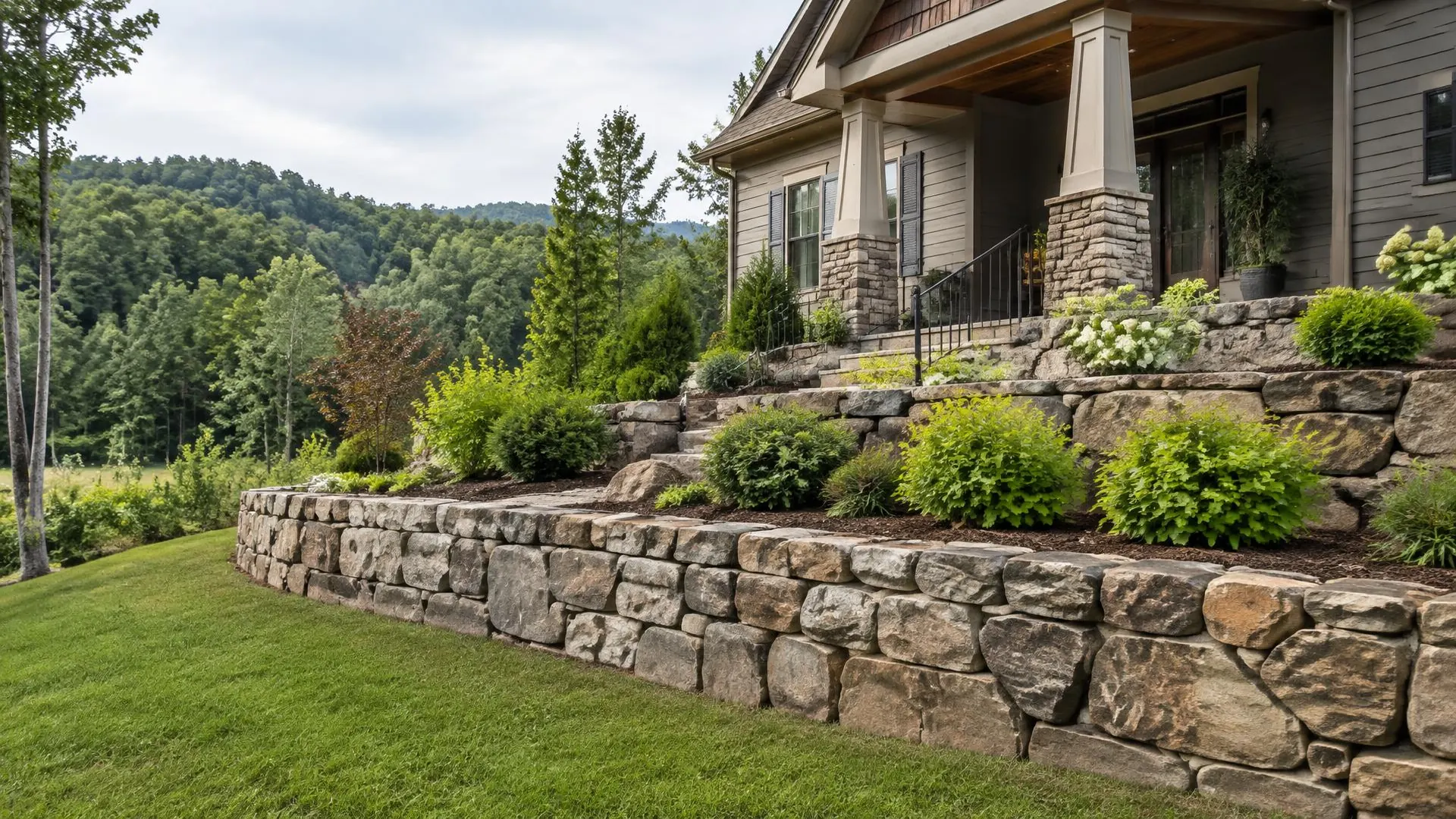
Retaining Wall Builder in Villa Rica, GA
Villa Rica's newer neighborhoods were carved out of rolling hills, and many lots here have a steep bank somewhere: behind the house, beside the driveway, or down toward a creek or lake. When that bank starts to slide, or the backyard is too steep to use, a retaining wall is usually the fix.
The Outdoors Group builds segmental block, natural stone and poured concrete retaining walls on both the Carroll County and Douglas County sides of Villa Rica. Every wall we build has drainage behind it, our own crew does the work, and we'll walk you through the city's rule for walls over four feet before anything is built. To get started, call (770) 545-4388 or request your free estimate below.
Building on Villa Rica's hills and lake banks
Villa Rica sits between about 1,000 and 1,300 feet above sea level, and the city's comprehensive plan describes the land as gentle to rolling hills, with severe slopes along some drainage ways. The plan names the steepest ground: along the major stream banks, on the south side of Lake Val-Do-Mar, and in the southern part of the city just north of Reed Road. Bedrock of schist and gneiss can be anywhere from a few inches to more than 25 feet down, and it runs shallow at the west end of Lake Val-Do-Mar.
Most of the city's homes are new. More than two-thirds were built in 2000 or later, according to NeighborhoodScout, and the typical lot is close to half an acre. Subdivisions like Northwoods at Mirror Lake and the homes along the Mirror Lake golf course were graded out of that hilly land, which often leaves a cut bank on one side of a lot and a fill slope on the other. Outside the city, Fairfield Plantation spreads across about 2,500 acres of rolling land around its lakes. Downtown and the old Fullerville mill community are another story: the city's 2023 plan points to aging structures there, and any old wall on one of those lots deserves a close look.
Villa Rica soil, and why drainage comes first
The city's planning documents say Villa Rica's soils are generally red and that soil erosion is fairly prevalent. The main soil groups are Madison-Tallapoosa and Davidson-Musella. Madison has a red clay subsoil, while Tallapoosa and Musella are shallow, with rock 10 to 20 inches down. The U.S. Department of Agriculture's type location for Musella soil is in Carroll County, so this is home ground for it. The plan rates slopes of 15 to 40% as having severe limits for any use, which is exactly the kind of ground a retaining wall can turn into usable yard.
None of these soils swell much when wet, but red clay holds water, and water is what tips walls over. Part of the city drains to the Little Tallapoosa River and part to the Dog River, which rises just south of town. During the September 2009 flood, the Dog River crested at 33.83 feet, according to the U.S. Geological Survey, and a gauge near Douglasville recorded 21.03 inches of rain in 24 hours. Behind a wall, that much water needs a way out: clean gravel, a perforated drain pipe and an outlet downhill.
Villa Rica's rule for walls over four feet
Villa Rica is stricter than many towns about taller walls. The city's residential permit checklist says retaining walls over four feet tall, measured from the footing, must be designed by a structural engineer and submitted to the Building Department for review. Because the height is measured from the footing, a wall that shows three and a half feet above the lawn can still cross that line once the buried course is counted.
Other city rules that shape where a wall can go:
- Land disturbance permits are approved by the Community Development Director, and disturbing more than an acre requires erosion plans stamped and approved by the Georgia Soil and Water Conservation Commission.
- The city has its own stream buffer, floodplain and wetland rules, on top of Georgia's 25-foot buffer along state waters.
- If your plat shows a drainage, pond or lake easement, or your front yard needs a tall wall, we check with the city before we plan a wall there.
We'll tell you at the free estimate whether your wall needs an engineered design.
Is your Villa Rica retaining wall failing?
- A bulge has formed partway along the wall
- The wall leans out toward the yard below it
- Water runs out of the joints or across the face after rain
- Blocks have slid, cracked or dropped off the top course
- A gap has opened between the wall and your steps, patio or foundation
- The soil behind the wall has dropped, or the lawn above it has cracked
- Old crossties or timbers have rotted through
A wall showing these signs is still moving, and a patch won't stop it. We demolish failing walls and rebuild them from a new base, with drainage behind them. If you're weighing your options, read why we rebuild leaning or cracked walls.
Our retaining wall process in Villa Rica
- Site visit and quote. We measure the wall's height from where the footing will sit, check the slope and the paths water takes across your lot, and give you a written quote.
- Engineering and permits, when needed. For walls over four feet from the footing, the city requires a structural engineer's design before building starts, and we'll walk you through that step.
- Georgia 811 and layout. Underground utilities are marked through Georgia 811 before digging, and the wall line is staked.
- Footing and drainage. We excavate, compact a gravel base, bury the bottom course and place clean drainage stone with a perforated pipe and filter fabric behind the wall.
- Wall and backfill. Each course is set and checked, reinforcement grid goes in where the design calls for it, and the backfill is compacted in lifts.
- Grading and cleanup. The ground above and below the wall is shaped to move water away from it, and the site is cleaned up.
Wall materials that suit Villa Rica homes
In the newer subdivisions, segmental concrete block is often the best fit: it comes in colors and textures that work with brick and stone fronts, and it can be reinforced for height. Natural stacked stone suits lakeside lots and garden terraces, where a softer, natural look matters. Poured reinforced concrete handles the hardest jobs, such as tall walls beside a driveway or along a tight property line. We also install stamped concrete patios and walkways that can tie into a new wall.
Retaining wall cost in Villa Rica
Our retaining walls cost $25 to $60 per square foot of wall face (height times length), depending on the material. Most residential walls run from $3,000 to $15,000 or more. The main things that move the price are the wall's height and length, the material, whether a structural engineer's design is required, how much rock or soil has to come out, and whether an old wall has to be demolished first.
You get a free on-site estimate and a written quote before any work begins. Financing is available, and every wall is backed by a written guarantee on our work.
Villa Rica neighborhoods we serve
We build retaining walls throughout Villa Rica and ZIP code 30180, on the Carroll County and Douglas County sides of town: downtown and Fullerville, the Mirror Lake community and its golf course homes, Lake Val-Do-Mar, Danielle Estates, Chadwick Place, the neighborhoods along Bankhead Highway and the subdivisions off I-20 exits 24 and 26, plus Fairfield Plantation south of the city. We also build walls in Carrollton, Bremen, Fayetteville, Fairburn and Peachtree City.
Villa Rica retaining wall questions
When does a Villa Rica retaining wall need an engineer?
Villa Rica's residential permit checklist says any retaining wall over four feet tall, measured from the footing, must be designed by a structural engineer and submitted to the Building Department. Under Georgia's residential code, a shorter wall over 24 inches that also holds up a driveway or building has to be engineered too.
How much does a retaining wall cost in Villa Rica?
Villa Rica walls we build run $25 to $60 per square foot of wall face based on material, and a typical home project lands between $3,000 and $15,000 or more. An engineered design, rock excavation or tearing out an old wall can add to the total. You'll get a free estimate and a written quote.
Can I build a wall in the drainage easement behind my house?
Check with the city first. A drainage easement carries water for more than one lot, and a wall that blocks that flow can flood a neighbor's yard or your own. Bring your plat to the estimate, and we'll find where the easement runs and confirm with the city what's allowed inside it.
Is Villa Rica's red clay bad for retaining walls?
The clay itself doesn't swell much, and USDA rates Madison soil low for shrink-swell. The risk is water. The city's plan says erosion is fairly prevalent here, and clay that stays soaked after a storm pushes hard on a wall with no drainage. Gravel backfill and a drain pipe behind the wall are what handle it.
Do you repair retaining walls in Villa Rica?
We replace them. When a wall leans or bulges, the base or the drainage behind it has usually failed, so we demolish it and build a new wall from the footing up.
How tall can a wall be in my Villa Rica front yard?
Front-yard walls can face height limits under Villa Rica's zoning, so if your plan needs a tall wall out front, we confirm the limit with the city before we build. A bigger grade change out front may need terraced walls or a different layout, which we can sketch out with you.
Does it matter which county my Villa Rica home is in?
Villa Rica's city limits reach into both Carroll and Douglas counties, and inside the city, the City of Villa Rica issues building permits on both sides of the line. If your address is in unincorporated Carroll, Douglas or Paulding County, the county issues the permit instead.
Get a Free Retaining Wall Estimate in Villa Rica
Get Your Free Estimate