
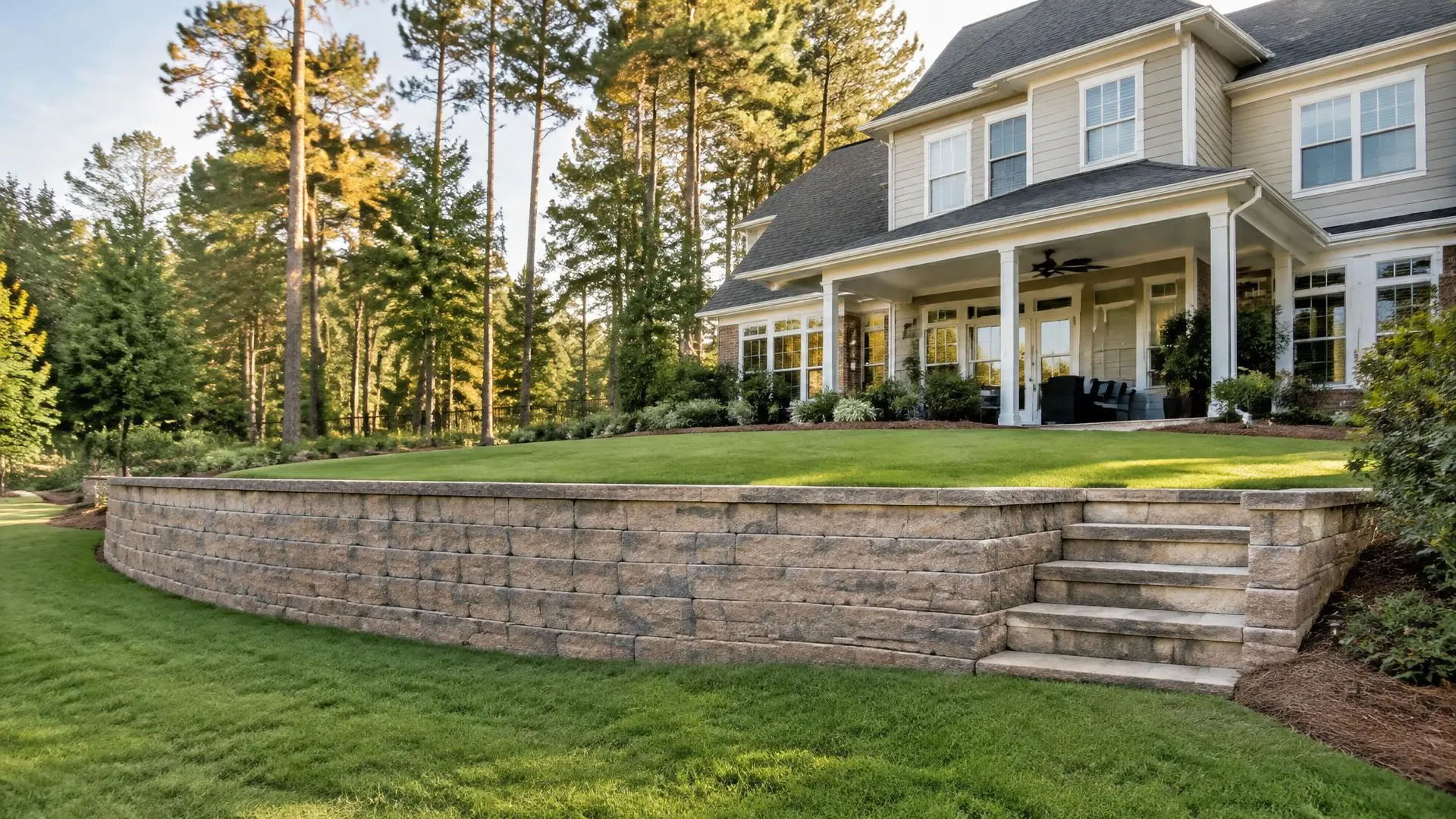
Retaining Wall Installation in Fayetteville, GA
Fayetteville grew fast in the 1990s and 2000s, and many of its subdivisions sit near Whitewater Creek, Gingercake Creek and the lakes and ponds around town. Plenty of those backyards slope down toward a creek, a pond or the neighbor's fence. A well-built retaining wall can level that ground, stop the erosion and give you a yard you can actually use.
The Outdoors Group builds segmental block, natural stone and poured concrete retaining walls throughout Fayetteville. We design each wall around where the water goes, we replace failing walls rather than patch them, and our own crew handles the work from start to finish. Call (770) 545-4388, or fill out the free estimate form below.
Runoff is the main problem behind Fayetteville walls
Water has a long record of testing walls here. In June 2003, the National Weather Service reported that the worst flash flooding in the south metro area hit western Fayetteville, between Pye Lake and Gingercake Creek, where floodwater pushed in a building wall on Cornwallis Way. In November 2015, after about three inches of rain in 48 hours, The Citizen reported that a seven-foot retaining wall at an office park on Habersham Drive was beginning to collapse. During Hurricane Helene in September 2024, the weather service's radar estimate put average rainfall across Fayette County at 8 to 10 inches.
The city has taken notice. In 2014, Fayetteville created the Pye Lake Southern Tributary Special Watershed District, about 362 acres around GA-54, after a study found that peak runoff at the Pye Lake outlet had climbed from about 21 cubic feet per second before development to about 149. More pavement and roofs mean more water reaching your yard, and more water pressing on any wall downhill from it. Every wall we build in Fayetteville has a drainage system designed to carry that water out and away.
What's under a Fayetteville yard
Fayetteville sits on the Piedmont, above schist, amphibolite and granite. A county geotechnical report for a site on GA-54 West near Piedmont Fayette Hospital describes the native soil there as mostly loose to medium dense silty sand, with clayey sand near the surface. That report found groundwater as shallow as five feet in places. Elsewhere in the county, the common soils include Cecil, Pacolet and Appling, which have red or brown clay subsoils that the U.S. Department of Agriculture rates low for shrink-swell.
That mix matters for wall design. Sandy soil drains better but can wash out from under a wall if water runs across the base, and clay subsoil holds water behind a wall after a long rain. Either way, the fix is the same: a compacted base set below grade, clean gravel and a perforated drain pipe behind the wall, and an outlet where the water can leave the yard without causing new erosion.
Fayetteville permits and water rules
Fayetteville handles its own building permits through the Building Department at City Hall on Stonewall Avenue West, and applications are filed online. The city's FAQ says a construction permit is needed for all new construction, remodeling and repairs, and the city publishes its own retaining wall permit application. Under Georgia's residential code, a wall holding back more than four feet of soil, or more than two feet with a driveway, building or other load above it, must be engineered.
Other rules that can affect a Fayetteville wall:
- The whole city lies within a water supply watershed, which is why stream buffers and runoff control get close attention here.
- Fayette County's largest connected floodplains run along Whitewater Creek and Line Creek, and Gingercake Creek has floodplain of its own.
- Georgia's 25-foot buffer applies along state waters, so walls near a creek or pond take extra planning.
- New development inside the Pye Lake special watershed district may need larger detention ponds and pipes, sized for the 100-year storm.
- In most Fayetteville subdivisions, common open space belongs to the homeowners association, so check your HOA's rules and your plat before building near a property line or common area.
- The city's development rules live in its Unified Development Ordinance, adopted in 2023 and last amended in March 2026.
We'll help you sort out which of these apply to your lot during the free estimate.
When a Fayetteville wall needs replacing
- The top of the wall has started to lean away from the slope
- One section bulges out farther than the rest
- Soil or gravel is washing out from under the bottom course
- Water seeps through the wall face long after the rain stops
- Blocks have cracked, slipped or separated at the corners
- The lawn or patio above the wall is sinking or pulling away
- A timber wall from the original build has started to rot
These are signs the wall's base or drainage has already failed, and surface repairs won't hold. We demolish failing walls and build new ones from the footing up, with proper drainage. Our article on rebuilding leaning or cracked retaining walls explains why.
Our process for Fayetteville retaining walls
- On-site estimate. We look at the slope, the soil, the downspouts and the path water takes across your property, measure the wall area and give you a written quote.
- Design and approvals. When a wall needs an engineer under the state code, or sits near a creek, a buffer or HOA common area, we plan for that before any digging.
- Locate utilities. Georgia 811 marks buried lines before excavation starts, and we stake the wall layout.
- Base and first course. We dig down to firm soil, compact a gravel base and bury the first course so the wall can't slide forward.
- Drainage and build. Each course goes up with clean stone, filter fabric and a perforated pipe behind it, plus reinforcement grid where the design needs it, and the backfill is compacted as we go.
- Grading and outlet. We shape the slope so water moves away from the wall, make sure the drain pipe has a safe outlet and clean up the site.
Wall materials for Fayetteville homes
Segmental concrete block is the most popular choice in Fayetteville subdivisions because it is strong, it can be reinforced for taller walls, and it comes in finishes that suit HOA standards. Natural stone works well for garden terraces, lake and pond edges, and the historic homes near downtown. Poured reinforced concrete is best for walls beside driveways, along tight property lines or holding up a heavy load. Our crews also pour stamped concrete patios and walkways, so the wall and the patio can be planned together.
Fayetteville retaining wall pricing
Our retaining walls cost $25 to $60 per square foot of wall face (height times length), depending on the material. Most residential walls total between $3,000 and $15,000 or more. In Fayetteville, the cost depends mainly on the wall's height and length, the material, how much drainage and grading the lot needs, whether an engineer must design the wall, and whether an old wall has to come out first.
Every project starts with a free on-site estimate and a written quote. Financing is available, and each wall comes with a written guarantee on our work.
Fayetteville neighborhoods we serve
We build retaining walls in and around Fayetteville, across ZIP codes 30214 and 30215: the downtown historic district, Lakemont, Weatherly Park, Country Lake, Riverbend Overlook, Pinehurst at Rivers Edge, Diamond Ridge, Quail Hollow, Magnolia Ridge, Legacy Hills, Sawgrass and Morning Falls, the homes near The Ridge Nature Area and along Redwine Road, and the neighborhoods off GA-54, GA-85, GA-92 and GA-314. We also build walls in Peachtree City, Fairburn, Carrollton, Villa Rica and Bremen.
Related hardscape services
Fayetteville retaining wall FAQs
Do I need a permit to build a retaining wall in Fayetteville?
Inside city limits, the Fayetteville Building Department issues permits, and the city publishes its own retaining wall permit application. Its FAQ says a permit is needed for all new construction, remodeling and repairs. Georgia's residential code also requires an engineered design for walls holding back more than four feet of soil, or more than two feet with a load above them.
What does a retaining wall cost in Fayetteville?
Our Fayetteville walls are priced at $25 to $60 per square foot of face area, depending on the material, so most homeowners spend $3,000 to $15,000 or more. Extra drainage work, an engineered design or removing an old wall can add to the total. There's no charge for the estimate, and the quote comes in writing.
Why do retaining walls fail in Fayetteville?
Most failures come down to water. Fayetteville has a history of heavy runoff, from the 2003 flash flood near Pye Lake to the 2015 storm that left an office park wall on Habersham Drive beginning to collapse. A wall without gravel backfill and a working drain lets water build up behind it until the wall leans or gives way.
Can a retaining wall help with erosion in my backyard?
Yes. A wall can turn a steep, eroding slope into level ground, and terraced walls can handle bigger grade changes. The key is pairing the wall with grading and a drain outlet so the water that caused the erosion has somewhere safe to go.
Does my HOA have to approve a retaining wall?
It depends on your HOA. In most Fayetteville subdivisions, the homeowners association holds the common open space, and many HOAs have rules about exterior changes. Check your covenants before you start, and we can give you drawings and material details to include with an HOA request.
Can you fix my leaning retaining wall instead of replacing it?
We don't patch leaning walls, because the lean means the base or drainage behind the wall has failed. We tear the wall out and build a new one on a solid footing with drainage behind it.
Can you build a retaining wall near a creek in Fayetteville?
Sometimes. The entire city is in a water supply watershed, Georgia protects a 25-foot buffer along state waters, and stream buffer rules apply near creeks. We'll look at where your lot sits and plan the wall to stay out of protected areas.
Get a Free Retaining Wall Estimate in Fayetteville
Get Your Free Estimate