
Hardscape Contractor in Peachtree City, GA
In Peachtree City, getting around the yard matters almost as much as getting around town. A lot of households here move between the garage, the backyard and the shared-use paths on a golf cart, a bike or on foot, and the original builder walks rarely planned for any of that. Many of them are narrow strips of concrete that have settled, cracked or started to tip toward the lawn.
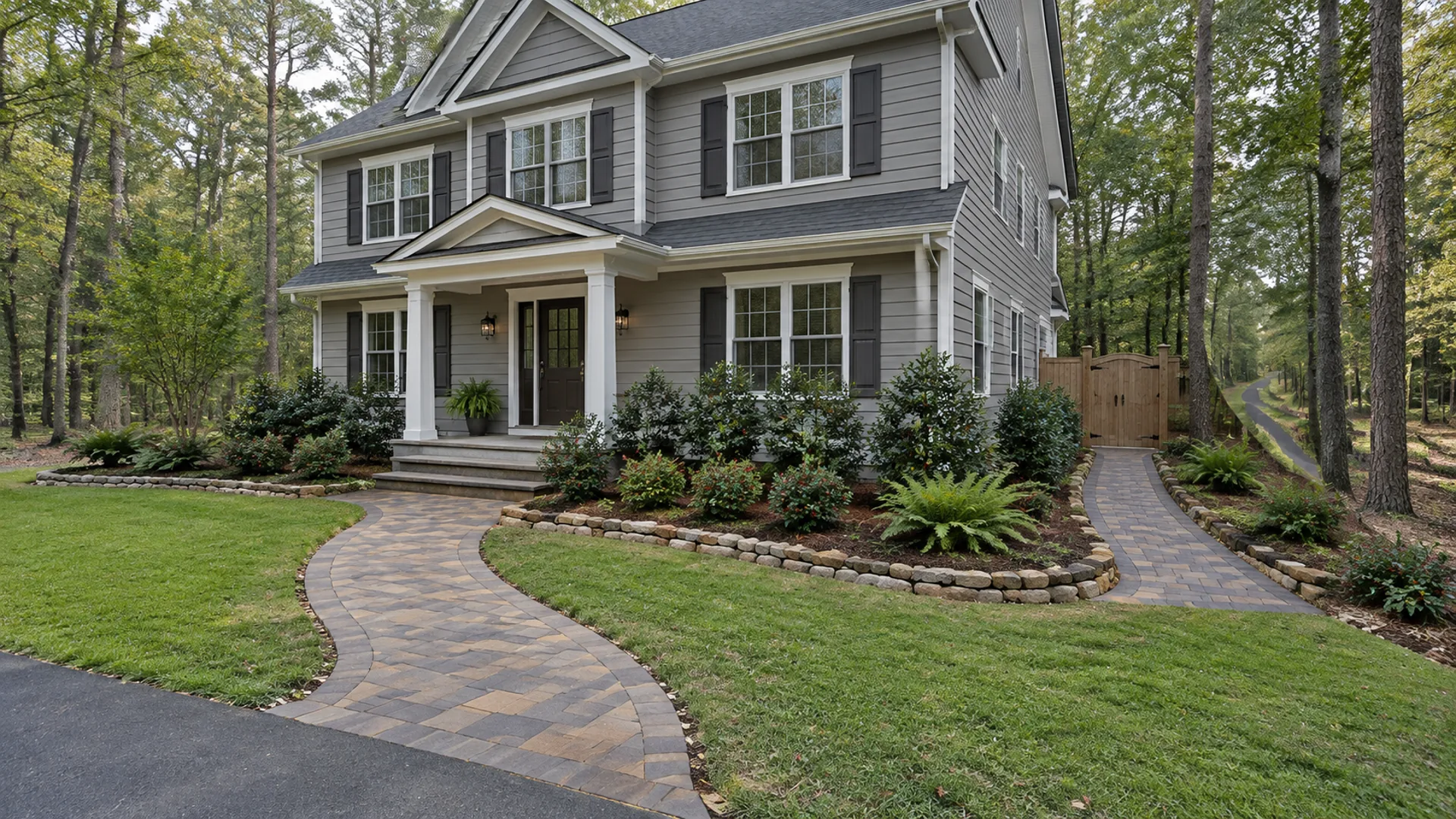
The Outdoors Group builds hardscapes for Peachtree City homes: front walks, steps and landings, side paths wide enough for a cart, garden paths, seating walls and stone borders. Our own crew does the work from our Carrollton office, and we've built outdoor projects across West Georgia since 2009. For a free hardscape estimate, phone (770) 545-4388 or send the form.
Stone walkways, steps and seating walls for Peachtree City homes
- Front walks in pavers, flagstone, brick or broom-finished concrete
- Wider stoops and landings with low, deep steps at the front door
- Side paths from the driveway to the backyard, sized for a golf cart where you need one
- Walks from the back patio out toward the yard's edge and the woods
- Garden paths and stepping stones through shade beds
- Low seating walls and raised planters with a finished cap
- Stone, brick or block edging between beds, lawn and paths
Where a path runs down a slope or along a bank that needs holding, we build that section the same way as our Peachtree City retaining walls.
Tying a yard into the cart path network
The city describes its system as a network of shared-use paths of more than 100 miles, and many backyards sit right beside one of them or beside the wooded greenbelt they run through. It's natural to want a walk or a short cart path from the back of the lot to the public path. The city's Engineering Department handles a Multi-Use Path Encroachment Permit for that kind of connection, so before we design a link to a city path, we confirm with Engineering what your connection needs.
Two other rules shape where a path can go. The greenbelt land behind many lots belongs to the city, and the city's tree permit application says removing trees on city-owned property is prohibited and can bring fines, so we keep our clearing on your side of the line. And not every path in town is public: the Atlanta Journal-Constitution reported in 2017 that the golf-club paths at Flat Creek, Braelinn and Planterra are private and for golfers only. We check your plat and the path you want to reach before laying anything out.
Sizing walks and gates for a golf cart
To be registered for the city's paths, a golf cart must weigh under 1,300 pounds, measure no more than 50 inches wide including the wheels and go no faster than 20 miles per hour. That width is a useful design number. A side path, a backyard gate or a parking spot beside the garage that a cart will use has to be comfortably wider than the cart itself, with room to steer around a corner.
We lay out cart routes with gentle turns, a firm base under the full width and a surface that won't rut when it's wet. A cart path from the driveway to the backyard can be pavers, stamped concrete or broom-finished concrete, and it can share the route with the walk you use every day.
Building for long wear in Peachtree City
Peachtree City's 2022 comprehensive plan encourages "high quality building materials to reduce long-term maintenance liability," and that is a fair rule for a front walk too. A walk that starts cheap and has to be patched, mudjacked or replaced in a few years costs more over the life of the house than one built properly the first time.
For us that means digging down to firm soil, compacting crushed stone in layers, setting a solid edge restraint and choosing a surface that holds up to cart tires, bikes and foot traffic. Pavers and natural stone can come up and go back down in a single section if a root or a utility repair ever calls for it, without tearing out the whole walk.
Drainage for Peachtree City walks and landings
The CoCoRaHS weather station in Peachtree City lists a normal of about 50.5 inches of rain a year, with March and July the wettest months and October the driest. On the wooded lots that are common here, that rain often runs off the roof and down through the beds toward the walk, and a flat or back-sloped walk turns into a puddle or a muddy edge.
We set every walk and landing with a slight slope that carries water off to the side, keep the surface below the siding and door thresholds, and leave a clear path for runoff where the lot drains toward a greenbelt or creek. If the plan includes a patio out back, our page on patio design and construction covers how we handle it.
Choosing a surface for a Peachtree City walk or path
- Concrete pavers: many colors and shapes, strong enough for cart traffic and easy to reset.
- Flagstone: irregular natural stone that suits wooded lots and shade gardens.
- Clay brick: a traditional look laid in running bond, herringbone or basketweave.
- Stamped concrete: one continuous surface with a stone or brick pattern.
- Broom-finished concrete: plain, durable and the simplest choice for a cart route.
- Fieldstone and granite: borders, steppers and solid step treads.
Under each of them, the base work is the same, and the base is what decides whether a walk stays flat.
Permits and HOA review in Peachtree City
Peachtree City's permits page names accessory structures, additions and retaining walls of 4 feet or more as work that needs a permit. Walks and other flatwork aren't named, and the page doesn't call them exempt, so we ask the Building Department about your walk or path before we start.
Most Peachtree City neighborhoods also have a homeowners association, and many review exterior changes. We provide the drawings, material choices and samples your association asks for, and we wait for approval before any work begins.
How we build hardscapes in Peachtree City
- Walk the property. We look at how you move between the driveway, the doors, the backyard and any nearby path, and where water flows in a storm.
- Plan and price. Routes, widths and materials are settled with you, and the price comes to you in writing.
- Sign-offs. We check city permit needs, any path connection with Engineering and your HOA's review.
- Locate utilities. Georgia 811 marks buried lines before we stake out the work.
- Remove the old work. Cracked concrete, loose stone or old timbers are broken out and hauled off.
- Build the base. Crushed stone is compacted in layers to the full width of the walk or path, and the edges are set.
- Lay and finish. Pavers, stone, brick or concrete go in, the joints get sand or mortar, and topsoil is brought back up to the new edges.
Pricing a Peachtree City hardscape project
We quote hardscapes after we see the site. The length and width of each walk or path, whether it has to carry a golf cart, the material and pattern, the number of steps and landings, how much old concrete comes out, any seating wall or planter and any permit, path connection or HOA requirement all set the price.
There's no charge for the visit or the estimate, the quote arrives in writing, the finished work is backed by our written guarantee, and you can finance it.
Hardscaping across Peachtree City
Our hardscape crews work all over Peachtree City's 30269 ZIP code. That covers the older streets of Aberdeen near Lake Peachtree, the cul-de-sacs of Glenloch and Braelinn, the hillier lots of Kedron, newer homes in Wilksmoor, the neighborhoods around the Lexington and Wilshire village centers, and communities such as Smokerise Plantation, Stoneybrook Plantation and Whitfield Farms. We also build hardscapes in Fairburn, Fayetteville, Villa Rica, Carrollton and Bremen.
Related hardscape services
More hardscape services in Peachtree City
Peachtree City hardscaping FAQs
Can you build a path from my backyard to the city cart path?
Often, yes. Peachtree City's Engineering Department handles a Multi-Use Path Encroachment Permit for connections to the path system, so we confirm what your connection needs before we design it, and we keep the work off city greenbelt land.
How wide should a side path be for a golf cart?
The city registers carts up to 50 inches wide, wheels included. We make a cart path comfortably wider than that, with room to turn, and build the base under the full width.
Is a front walk on Peachtree City's permit list?
The city's permits page doesn't name walks or other flatwork, and it doesn't call them exempt either. We ask the Building Department about your project first.
Can I use the golf course paths near my house?
The golf-club paths at Flat Creek, Braelinn and Planterra were reported in 2017 to be private and for golfers only. We design connections to public paths, not private club paths.
Will my HOA need to approve the work?
Many Peachtree City associations review exterior changes. We prepare the plans and material samples for your request and begin once it's approved.
What lasts longest for a walk on a wooded lot?
Pavers and natural stone on a well-compacted base hold up well under trees, and a single section can be lifted and reset if a root or repair calls for it.
How much does hardscaping cost in Peachtree City?
Size, whether the path must carry a cart, material, steps, removal of the old walk and any permit or HOA work set the price. We price it after a free visit, in writing, and financing is offered.
Get a Free Hardscape Estimate in Peachtree City
Get Your Free Estimate