
Why Your Attic is a 5-Star Hotel for Bats!
May 7, 2025
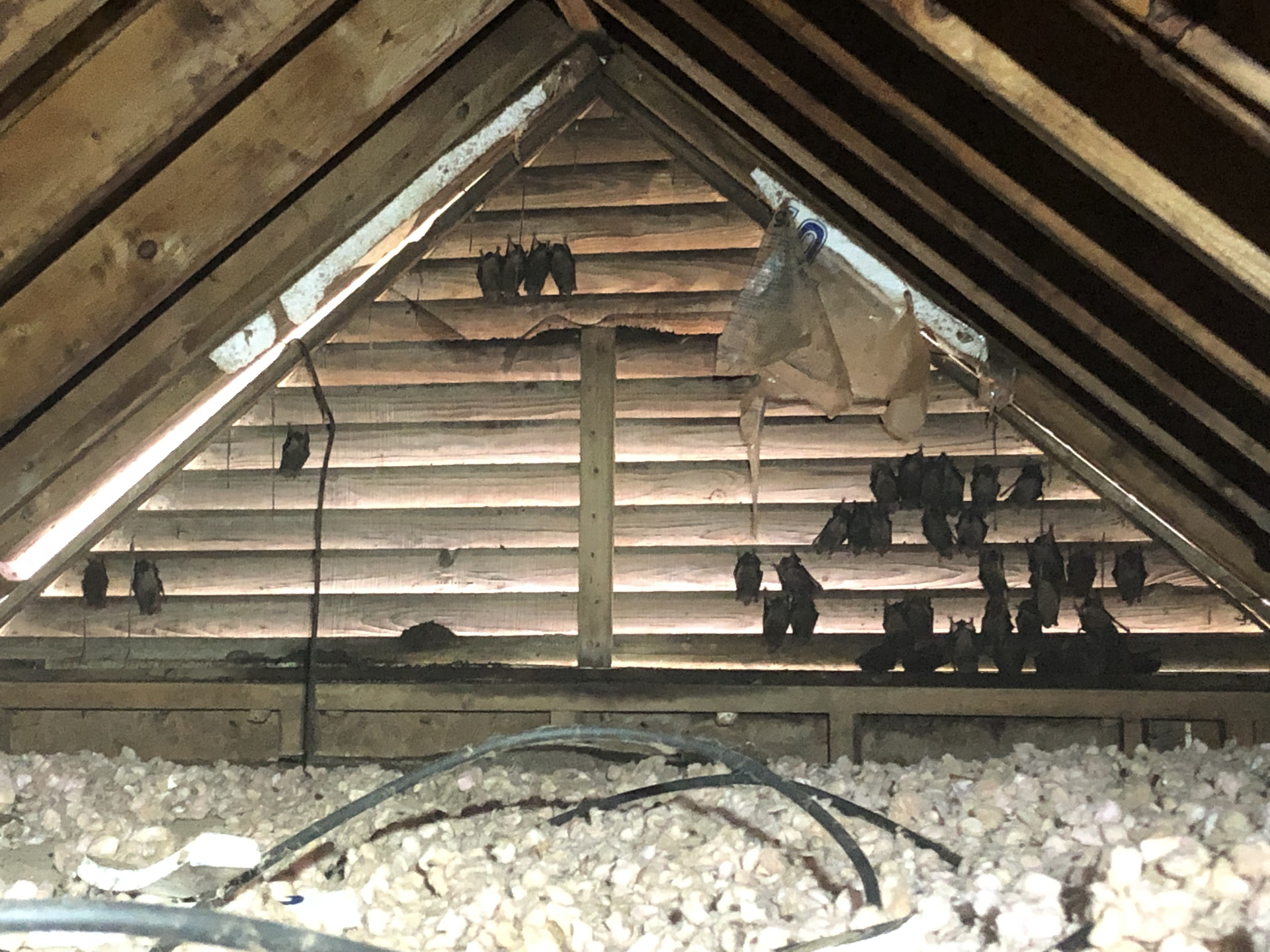
A homeowner in Sandy Springs called us last August after noticing something unsettling: every evening around dusk, she'd see a stream of dark, darting shapes emerging from the eave of her two-story colonial. At first she counted five or six. By the time she called us, she estimated thirty to forty bats pouring out of a gap between her fascia board and roof decking every single night.
When our technician inspected the attic, the reality was even more dramatic. An estimated colony of 80–100 big brown bats had established a maternity roost in the south-facing section of her attic. The insulation below the roost was buried under several inches of guano — dry, dark pellets that crumbled into dust when disturbed. The smell was overwhelming. And because it was August — the middle of maternity season — we couldn't legally begin exclusion for another two weeks.
Her situation, while striking, is far more common than most Metro Atlanta homeowners realize. Georgia is home to 16 bat species, and several of them actively seek out residential attics as roost sites.
Why Bats Choose Your Attic
Stable temperature. Bats — particularly maternity colonies of breeding females — need consistent warmth for their pups to develop. Your attic, heated by the Georgia sun, maintains temperatures between 90–120°F in summer — ideal for bat pup development.
Darkness and seclusion. Bats are nocturnal and prefer dark, undisturbed spaces. Most homeowners rarely enter their attics.
Proximity to food. Metro Atlanta's abundance of insects provides a rich food source. A single big brown bat eats 1,000–3,000 insects per night.
Small entry points. Most Georgia bat species can enter through a gap as small as 3/8 of an inch — roughly the width of a dime.
Georgia's Most Common Attic Bats
Big brown bat (Eptesicus fuscus). The most common attic bat in our region. Body length 4–5 inches, wingspan 12–13 inches. They form maternity colonies of 20–300 females, giving birth to 1–2 pups in late May or June.
Evening bat (Nycticeius humeralis). Slightly smaller than the big brown bat. Forms maternity colonies of 25–100 in attics.
Brazilian free-tailed bat (Tadarida brasiliensis). More common in south Georgia but occasionally found in Metro Atlanta attics.
Little brown bat (Myotis lucifugus). Once common but populations have declined dramatically due to white-nose syndrome.
Legal Protections: Why You Can't Just Remove Bats Anytime
Bats are protected under Georgia law. It is illegal to kill bats in Georgia. All removal must be done through exclusion.
Maternity season restrictions. Georgia's bat maternity season runs approximately from May 1 through August 15. During this period, exclusion is prohibited because non-flying pups would be trapped inside.
Federal protections. Several Georgia bat species are listed as threatened or endangered under the federal Endangered Species Act.
The Sandy Springs homeowner called us in August — right in the middle of maternity season. We had to wait until mid-August to begin exclusion.
Health Risks: Guano and Histoplasmosis
Bat guano (droppings) is the primary health concern. The key health risk is histoplasmosis — a respiratory infection caused by the fungus *Histoplasma capsulatum*, which grows in bat guano.
How infection occurs: When dried guano is disturbed, it releases microscopic spores into the air. Inhaling these spores can cause histoplasmosis, ranging from mild flu-like symptoms to severe, chronic lung infection.
Other guano risks: Bat guano can stain ceilings, create persistent odors, attract secondary insects (bat bugs, carpet beetles), and reduce insulation effectiveness.
Guano cleanup requirements: Full PPE, dampening before removal, and HEPA-filtered air containment. This is not a DIY job.
The Sandy Springs attic had an estimated 200+ pounds of accumulated guano across a 15-foot by 8-foot area.
The Professional Bat Exclusion Process
Step 1: Inspection and colony assessment. We inspect the attic interior to assess colony size and evaluate guano accumulation. We inspect the entire exterior to identify all entry and exit points.
Step 2: Timing. We schedule exclusion for the legal window — before May 1 or after August 15. The ideal timing in Georgia is September through November.
Step 3: One-way exclusion device installation. We install bat valves at all identified exit points. These remain in place for 5–7 days to ensure the entire colony has exited.
Step 4: Permanent sealing. Once the colony has fully exited, we permanently seal every entry point as part of a complete wildlife exclusion process. Every gap 3/8 inch or larger on the entire roofline is sealed.
Step 5: Guano removal and [attic restoration](/blog/attic-restoration-guide/). Contaminated insulation and guano are removed following hazmat protocols. The attic is sanitized, deodorized, and re-insulated.
Cost of Professional Bat Removal in Metro Atlanta
- Bat exclusion only (small colony, few entry points): $600–$1,200
- Exclusion + moderate guano cleanup: $1,200–$2,500
- Exclusion + full attic restoration (large colony): $3,000–$7,000+
The Sandy Springs project — exclusion of an 80–100 bat colony, permanent sealing of 14 entry points, complete guano removal, insulation replacement, and full sanitization — cost $5,800. The homeowner's insurance covered $3,200.
What NOT to Do About Bats
- Don't use poison or pesticides. It's illegal to kill bats in Georgia.
- Don't attempt to seal bats inside. Trapped bats will die in your attic, creating odor and health hazards.
- Don't attempt guano cleanup without proper equipment. Disturbing guano without respiratory protection exposes you to histoplasmosis.
- Don't hire a company willing to exclude during maternity season. If a company offers to exclude bats between May and August, they're either ignorant of the law or willing to break it.
Get Professional Help
The Outdoors Group is one of Metro Atlanta's most experienced bat removal companies. We've excluded bat colonies from homes across Fulton, Cobb, DeKalb, Gwinnett, Forsyth, and surrounding counties since 2009. Every bat exclusion includes full-perimeter sealing and is backed by our 100% written guarantee.
Call (770) 802-1411 today or schedule your free inspection online.