
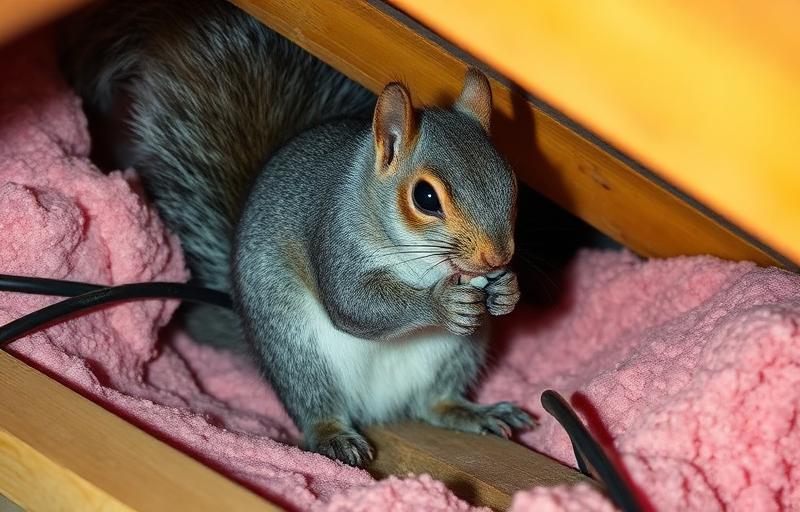
How to Get Rid of Squirrels in Your Attic (The Right Way)
February 19, 2026
A homeowner in Roswell called us in early March, frantic. She'd been hearing scurrying in her attic for about two weeks and had already tried two DIY approaches: mothballs scattered across the attic floor and a battery-powered ultrasonic repeller she'd bought online. Neither had any effect. When she went into the attic to add more mothballs, she discovered the real problem — a mother gray squirrel had built a nest of shredded insulation in the corner, and inside the nest were four tiny, hairless baby squirrels, each about the size of her thumb.
Now she was stuck. She couldn't seal the hole because the babies couldn't survive without their mother. She couldn't trap the mother because the babies would die. The ultrasonic device was useless. The mothballs just made her attic smell terrible. And every day she waited, the mother squirrel was chewing more insulation, creating more damage, and widening her entry hole.
This exact scenario plays out hundreds of times each spring across Metro Atlanta. March through May is the peak of squirrel baby season in Georgia, and it's the worst possible time to attempt DIY squirrel removal. Here's why — and what actually works.
Why Squirrels Love Your Attic
Your attic provides everything a squirrel needs to survive and raise young: warmth, shelter from predators (hawks, owls, cats, and snakes), protection from rain and wind, and a safe, enclosed space for nesting. Georgia's two most common squirrel species — the Eastern gray squirrel and the Southern flying squirrel — both seek out attics when natural tree cavities are unavailable.
Georgia Squirrel Breeding Calendar
Understanding squirrel breeding patterns is essential for effective removal, because babies in the attic change everything about how the job must be handled:
- December–January: Mating season for the first litter. Males become very active, chasing females across roofs and through trees.
- February–March: Pregnant females seek out den sites — including your attic. They'll enlarge existing gaps or chew new holes to enter.
- March–April: First litter is born. Litters average 3–5 babies. Newborns are blind, hairless, and completely dependent on the mother. They cannot leave the nest for 8–10 weeks.
- April–June: Babies develop fur, open their eyes (around week 5), and begin exploring the attic. By week 10–12, they're mobile enough to leave through the entry hole.
- June–July: Mating season for the second litter begins.
- August–September: Second litter is born. Same 8–10 week dependency period.
- October–November: Second-litter babies become independent. Both litters may continue using your attic as a den through winter.
This calendar means that for roughly 6 months out of every year (February–April and August–October), there's a strong possibility that any squirrel in your attic has dependent babies.
What Squirrels Damage in Your Attic
Squirrels chew. Constantly. Their front incisors grow continuously throughout their lives, and they must gnaw to keep them from overgrowing. Here's what they target:
Electrical wiring. This is the most dangerous damage. Squirrels chew through the plastic insulation on Romex wiring, exposing bare copper conductors. In an attic full of dry insulation, a short circuit from chewed wiring can start a house fire.
Insulation. Squirrels shred fiberglass batt insulation for nesting material and compress blown-in insulation by running across it repeatedly.
Wood framing. Squirrels gnaw on rafters, joists, and fascia boards.
PVC pipes and ductwork. Squirrels chew through PVC plumbing vents and HVAC flex ducts.
Roof components. Squirrels enlarge their entry holes over time, chewing through roof decking, drip edge, and shingles.
The Roswell homeowner's damage assessment after just three weeks of squirrel activity: two chewed electrical wires, approximately 150 square feet of contaminated insulation, gnaw marks on four rafters, and one torn HVAC duct. Estimated repair cost: $2,400.
Why DIY Squirrel Removal Fails
Mothballs and chemical repellents: No repellent — commercial or homemade — has been scientifically proven to drive squirrels from an attic. Mothballs (naphthalene) are actually toxic to humans and pets in enclosed spaces and are illegal to use as a pesticide.
Ultrasonic devices: Multiple independent studies have shown that ultrasonic repellers have no measurable effect on squirrel behavior. Squirrels habituate to the sound within hours.
Live traps without exclusion: You can catch a squirrel, but if you relocate it, another moves into the same entry point within days.
Sealing holes with the wrong materials: Expanding foam, caulk, and lightweight screening all fail. Squirrels chew through expanding foam in minutes.
Sealing holes at the wrong time: Sealing during baby season traps babies inside.
The Professional Approach: How We Remove Squirrels Permanently
Here's exactly how The Outdoors Group handles squirrel removal — a process we've refined through thousands of jobs across Metro Atlanta:
Step 1: Comprehensive inspection. We inspect every inch of your roofline, soffits, fascia, gable vents, construction joints, and foundation. We identify all active entry points, all potential entry points, and all existing damage. We check for babies. This inspection is always free.
Step 2: Baby check. During breeding season, we specifically check for babies. If babies are present, we modify our approach — we'll either wait for them to become mobile or use reunion techniques to ensure the mother relocates them safely.
Step 3: One-way exclusion. We install one-way exclusion devices at active entry points. Squirrels leave naturally to forage but can't get back in. This is the most humane and effective removal method.
Step 4: Complete exclusion. Once all squirrels have exited (typically 3–5 days, confirmed through monitoring), we permanently seal every entry point using galvanized steel flashing, commercial-grade screening, and construction-grade sealants.
Step 5: Damage repair and [restoration](/blog/attic-restoration-guide/). We repair all chew damage: chewed wiring is replaced, damaged ductwork is repaired, contaminated insulation is removed and replaced, and all surfaces are sanitized and deodorized.
Cost of Professional Squirrel Removal in Metro Atlanta
- Basic squirrel removal and exclusion (minor damage): $300–$800.
- Removal + exclusion + moderate repair: $800–$1,500.
- Removal + exclusion + full attic restoration: $2,000–$5,000+.
Every project starts with a free inspection and a written proposal with all costs detailed before any work begins.
Does Insurance Cover Squirrel Damage?
Most standard homeowner's insurance policies in Georgia do not cover the removal itself, but many cover the resulting damage — particularly wiring damage, roof damage, and insulation replacement. We provide detailed damage documentation and itemized invoices that our customers have successfully used for insurance claims.
Prevention: Keeping Squirrels Out for Good
- Trim tree branches to at least 8 feet from your roofline.
- Annual [wildlife inspection](/blog/are-you-letting-pests-walk-right-in-why-you-need-a-professional-wildlife-home-inspection-today/).
- Monitor your roofline visually from the ground each season.
- Don't feed squirrels. Bird feeders attract squirrels to your yard — and once they're on your property, your roof is next.
Get Help Now
If you're hearing scurrying in your attic — especially during early morning or late afternoon — call a professional today. The Outdoors Group provides free inspections across Metro Atlanta and West Georgia. Every job includes full exclusion and is backed by our 100% written guarantee.
Call (770) 545-4388 or schedule your free inspection online. We'll get those squirrels out — the right way.